
Math Heuristics for Problem Solving
Primary 3 Constant Total (a.k.a. Total Unchanged) & Model Method
What is Constant Total in Math?
Constant Total is a type of math problem where you take some things away from one group and add them to another group, but the total amount always stays the same. For example, you might take three apples away from a basket and put them into another basket, but the total number of apples will still be the same.
Sometimes, these types of problems can be tricky to understand, especially for children. That’s why we use a special method called model drawing to help them visualize and solve the problem. One way to do this is to use the Change model method.
There are also two other ways to model problems: Part-whole and Comparison. Constant Total is also known by different names such as Internal Transfer, Total Unchanged, Unchanged Total, and Same in Same out.
How to Solve Constant Total Questions with Change Model Method?
Let's take a look at this Primary 3 word problem example:
Watch the tutorial for free!
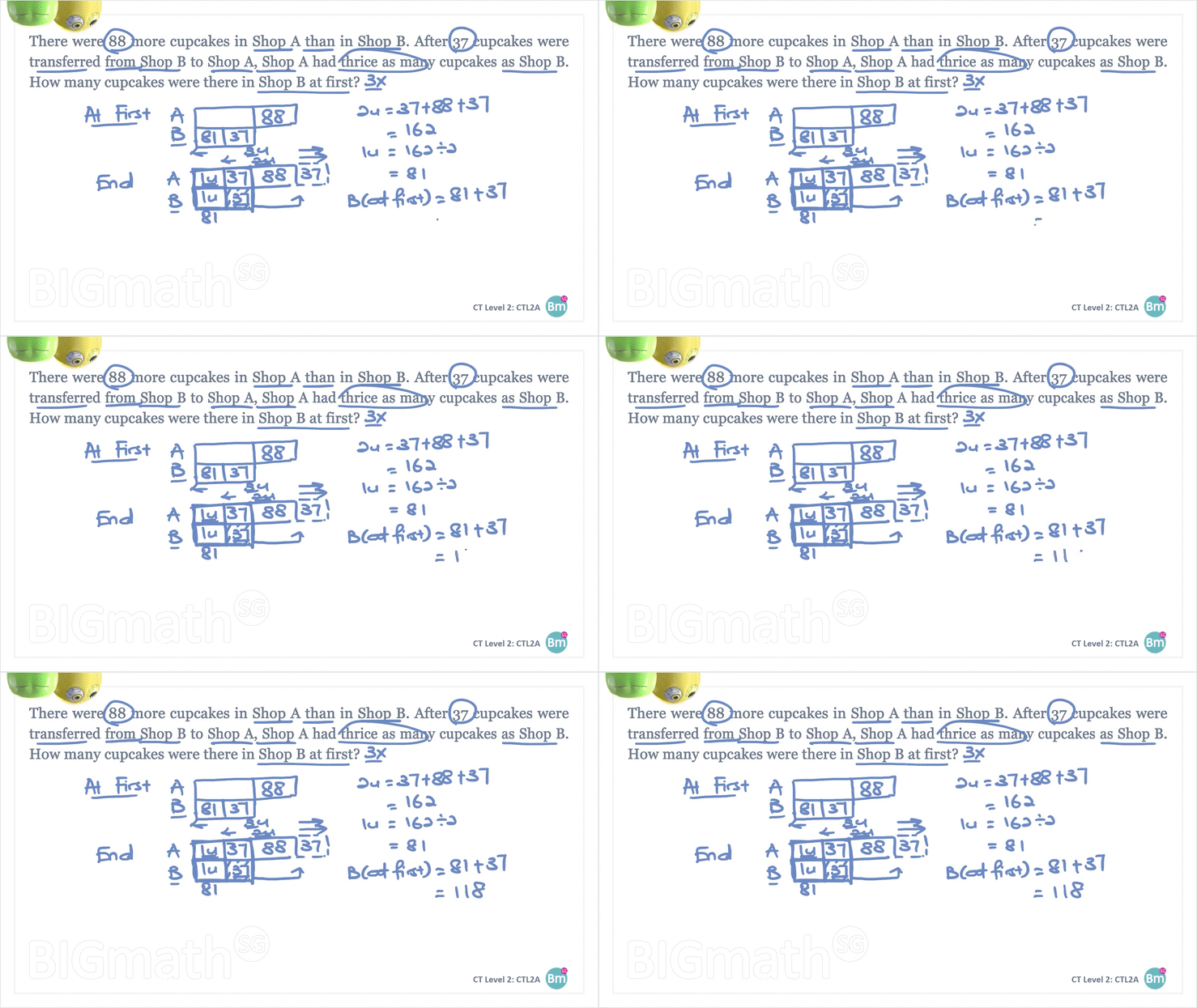
There were 88 more cupcakes in Shop A than in Shop B. After 37 cupcakes were transferred from Shop B to Shop A, Shop A had thrice as many cupcakes as Shop B. How many cupcakes were there in Shop B at first?
Identify the Concept
… sentence tells us this is a Constant Total concept question as…
Workings Explained
We need to draw 2 models as this is a “Before-After” question as some cupcakes were transferred from Shop B to Shop A.
- Label the 1st model “Before” or “At First”. Label “A” for Shop A and “B” for Shop B. The 1st sentence tells us that Shop A had more cupcakes than Shop B hence the model for Shop A must be longer than Shop B. Since Shop A had more cupcakes than Shop B, we can cut Shop A’s model into 2 parts. The 1st part of the model will have the same amount as Shop B. The 2nd part of the model will be the difference between the 2 shops. Write “88” in the difference box (the 2nd part of Shop A’s model).
- Bring the model down, label the model “After” or “End”. Cut Shop B’s model into 2 parts, do the same for Shop A’s model. Write “37” in the 2nd part of both Shop A and Shop B’s model as we are making parts equal. Shade the 2nd part of Shop B’s model as this is taken away from Shop B. Draw an arrow from the 2nd part of Shop B’s model and point to Shop A as it is now given to Shop A. Use dotted line draw a box in Shop A’s model and write “37” in it as the 37 cupcakes taken away from Shop B is now added to Shop A.
- Shop B is left with 1 part (an unknown amount), write “1u” (1 unit) in the box. Write “1u” for the 1st part of Shop A’s model as well as we had made parts equal. All the 4 parts of Shop A’s model will add up to 3 units as the 2nd sentence “Shop A had thrice as many cupcakes as Shop B.” tells us that Shop A had 3 times the amount Shop B had. The 1st part of Shop A’s model is 1 unit, we know the other 3 parts will add up to 2 units. 2 units = 162 (37 + 88 + 37 = 162), 1 unit = 81 (162 ÷ 2 = 81).
- To find the amount of cupcakes Shop B had at first, we will add 81 and 37 (Shop B is left with 1 unit in the end, which we know 1 unit is 81. Shop B gave Shop A 37 cupcakes. Add the amount Shop B had in the end and what Shop B gave to Shop A, that will give us the amount Shop B had at first).
Shop B had 118 cupcakes at first.
Identify the Concept
2nd sentence tells us this is a Constant Total concept question as the 37 cupcakes were transferred from Shop B to Shop A. The giving and receiving is between the 2 shops, hence the total will remain the same (the amount taken from Shop B were added to Shop A). That means the total at first and the total in the end are the same.
Workings Explained
We need to draw 2 models as this is a “Before-After” question as some cupcakes were transferred from Shop B to Shop A.
- Label the 1st model “Before” or “At First”. Label “A” for Shop A and “B” for Shop B. The 1st sentence tells us that Shop A had more cupcakes than Shop B hence the model for Shop A must be longer than Shop B. Since Shop A had more cupcakes than Shop B, we can cut Shop A’s model into 2 parts. The 1st part of the model will have the same amount as Shop B. The 2nd part of the model will be the difference between the 2 shops. Write “88” in the difference box (the 2nd part of Shop A’s model).
- Bring the model down, label the model “After” or “End”. Cut Shop B’s model into 2 parts, do the same for Shop A’s model. Write “37” in the 2nd part of both Shop A and Shop B’s model as we are making parts equal. Shade the 2nd part of Shop B’s model as this is taken away from Shop B. Draw an arrow from the 2nd part of Shop B’s model and point to Shop A as it is now given to Shop A. Use dotted line draw a box in Shop A’s model and write “37” in it as the 37 cupcakes taken away from Shop B is now added to Shop A.
- Shop B is left with 1 part (an unknown amount), write “1u” (1 unit) in the box. Write “1u” for the 1st part of Shop A’s model as well as we had made parts equal. All the 4 parts of Shop A’s model will add up to 3 units as the 2nd sentence “Shop A had thrice as many cupcakes as Shop B.” tells us that Shop A had 3 times the amount Shop B had. The 1st part of Shop A’s model is 1 unit, we know the other 3 parts will add up to 2 units. 2 units = 162 (37 + 88 + 37 = 162), 1 unit = 81 (162 ÷ 2 = 81).
- To find the amount of cupcakes Shop B had at first, we will add 81 and 37 (Shop B is left with 1 unit in the end, which we know 1 unit is 81. Shop B gave Shop A 37 cupcakes. Add the amount Shop B had in the end and what Shop B gave to Shop A, that will give us the amount Shop B had at first).
Shop B had 118 cupcakes at first.
Can the Change Model Method be used to solve other types of word problems?
The Change model method can be applied to solve various types of word problems. Some examples of word problem types that can be solved using the Change model method include,