
Math Heuristics for Problem Solving
Primary 3 Equal Amount (End) & Model Method
What is Equal Amount (End) in Math?
Equal Amount (End) is a math problem type where the amount of the items or people is the same after some change occurs. When solving word problems involving Equal Amount (At First), model drawing can be helpful for primary 3 children to visualize and simplify the problem. The Change model method is a good approach to use in this situation.
Equal Stage (After), Equal Stage (End), Equal Scenario (After) and Equal Scenario (End) are all different names that may be used to refer to this concept in some teachings.
How to Solve Equal Amount (End) Questions with Change Model Method?
Let's take a look at this Primary 3 word problem example:
Watch the tutorial for free!
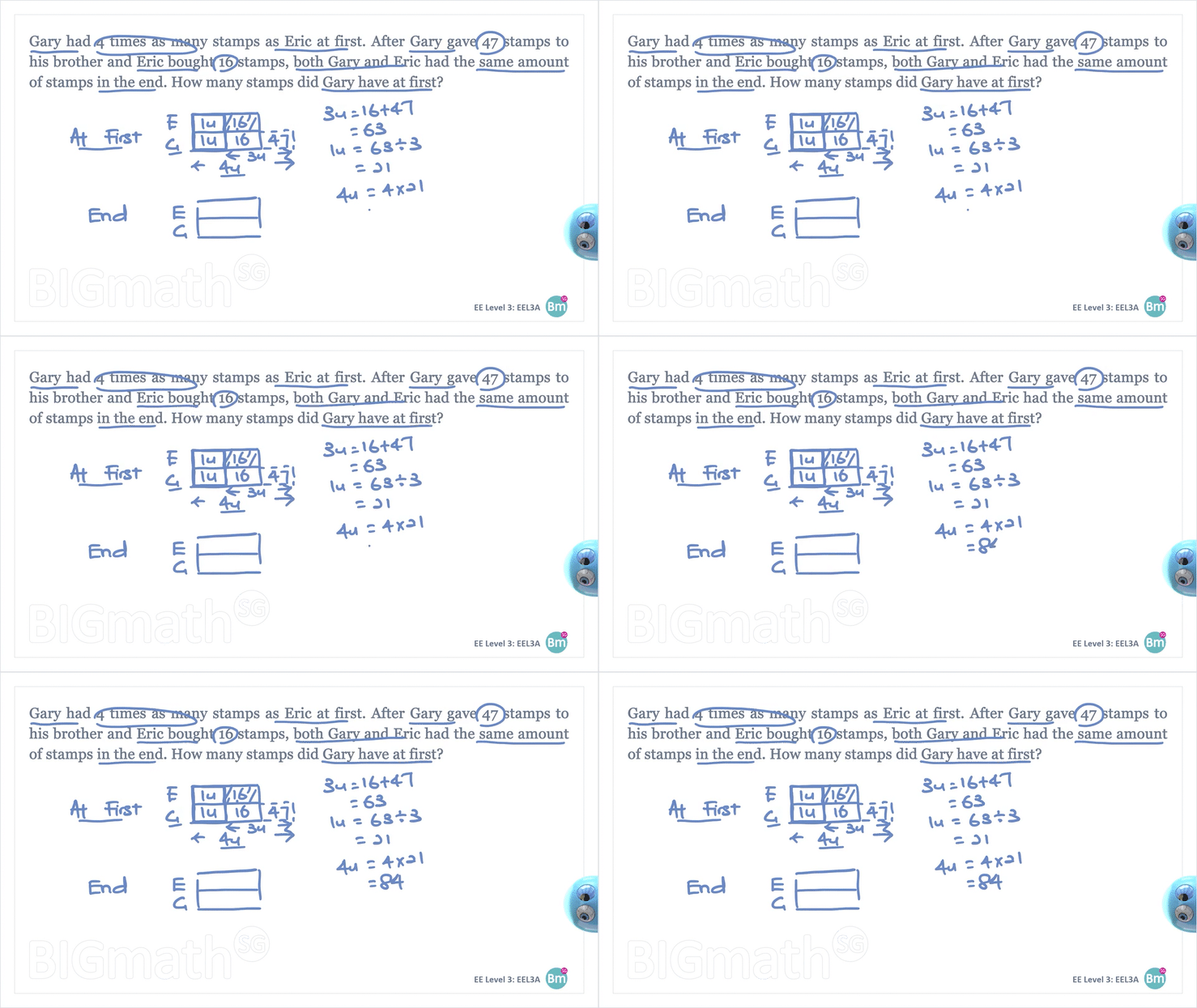
Gary had 4 times as many stamps as Eric at first. After Gary gave 47 stamps to his brother and Eric bought 16 stamps, both Gary and Eric had the same amount of stamps in the end. How many stamps did Gary have at first?
Identify the Concept
The … sentence tells us this is Equal Amount (End) concept question as…
Workings Explained
We will draw equal parts for both Gary and Eric. Label the models “End” or “After”. Label “G” for Gary’s model and “E” for Eric’s model. Bring the model up and label it “Before” or “At First”.
- Cut a part in Eric’s model, write “16” and shade as we are taking away 16 from Eric. “Eric bought 16 stamps”, instead of adding we need to subtract as we are working backwards, everything will be reversed. Cut the same for Gary’s model as we need to make parts equal. Write “16” in the part for Gary.
- Use dotted lines to draw a box for Gary as “Gary gave 47 stamps to his brother…”, instead of subtracting, we add as we are working backwards, everything will be reversed.
- Write “1u” (1 unit) for the 1st part of Eric’s model and write the same for Gary. All the 3 parts in Gary’s model will add up to 4 units as the 1st sentence said Gary had 4 times as many stamps as Eric. We know the 2nd part and the 3rd part of Gary’s model will add up to 3 units. 3 units = 63 (16 + 47 = 63). 1 unit = 21 (63 ÷ 3 = 21). To find the number of stamps Gary had at first, we just have to multiply 21 by 4 (4 × 21 = 84) as Gary had 4 units at first.
Gary had 84 stamps at first.
Identify the Concept
The last sentence tells us this is Equal Amount (End) concept question as both Gary and Eric had the same amount of stamps in the end. We will start from the end where both Gary and Eric had the same amount. If we start from the end, we are working backwards.
Workings Explained
We will draw equal parts for both Gary and Eric. Label the models “End” or “After”. Label “G” for Gary’s model and “E” for Eric’s model. Bring the model up and label it “Before” or “At First”.
- Cut a part in Eric’s model, write “16” and shade as we are taking away 16 from Eric. “Eric bought 16 stamps”, instead of adding we need to subtract as we are working backwards, everything will be reversed. Cut the same for Gary’s model as we need to make parts equal. Write “16” in the part for Gary.
- Use dotted lines to draw a box for Gary as “Gary gave 47 stamps to his brother…”, instead of subtracting, we add as we are working backwards, everything will be reversed.
- Write “1u” (1 unit) for the 1st part of Eric’s model and write the same for Gary. All the 3 parts in Gary’s model will add up to 4 units as the 1st sentence said Gary had 4 times as many stamps as Eric. We know the 2nd part and the 3rd part of Gary’s model will add up to 3 units. 3 units = 63 (16 + 47 = 63). 1 unit = 21 (63 ÷ 3 = 21). To find the number of stamps Gary had at first, we just have to multiply 21 by 4 (4 × 21 = 84) as Gary had 4 units at first.
Gary had 84 stamps at first.
Can the Change Model Method be used to solve other types of word problems?
The Change model method can be applied to solve various types of word problems. Some examples of word problem types that can be solved using the Change model method include,